Natasha Lloyd is a Medical Herbalist, the house forager for The Fife Arms, Braemar and a regular contributor to Some Good Ideas.
Alongside her friend and colleague, Rachel Simmons, Natasha has recently founded a herbal and foraging online course which you can find through her website, gatheringnature.com.
By Natasha Lloyd
This year I have been looking forward to spring more than ever. It’s been a long hard winter and the pandemic has turned our world upside down, with no way to gauge what will come next. But the arrival of spring is a constant, something we can -thankfully- rely on.
The first spring plants to emerge are perfect for reawakening our bodies and minds from a long winter slump, removing toxins, while cleansing and refreshing. Spending time outdoors and foraging for plants is a wonderful act of self-care, even before the benefits of the plant nutrients themselves, foraging helps our minds as we focus on the present.
1. Dandelion
Dandelion leaves start to appear very early and this is the stage they are at their best. They are a mild diuretic, gently moving any excess water out of our bodies. The slight bitterness in the leaves stimulates the vagus nerve, which helps improve and increase digestion. They are a wonderful addition to a salad and to a pesto.
By Walther Otto Müller2. Nettles
Nettles contain a long list of nutrients, providing a necessary boost after winter. Cooked in a similar way to spinach, nettles are delicious in soups or perhaps make a lemon and nettle cake, which is a beautifully vibrant green.
3. Cleavers
Cleavers or ‘sticky willy’ or ‘goosegrass’ has a rough stem that sticks easily to many fabrics. It is a diuretic, so has cleansing properties and will stimulate digestion. The young leaves are delicious and taste of pea pods. The whole young plant can be juiced and either drunk as it is or added to smoothies or soups.
4. Birch sap
Birch sap has a very slightly sweet flavour and viscous texture, due to the amount of xylitol it contains. We can benefit from the same nutrients that help the silver birch awaken after winter, by taking small portions of birch sap for ourselves. Traditionally it was used to help relieve mild joint issues that may have built up over the inactive colder months. The sap only rises for a few weeks in early spring then the leaves start to appear.
5. Ground elder
Ground elder or ‘goutweed’ or ‘bishops weed’ along with dandelion, this is one of the first leaves of spring and a welcome addition. It has a parsley/celery flavour that is a great addition to most dishes. Brought to Britain by the Romans as a food and medicine, its’ medicinal properties are as the name suggests: good for gout. It helps remove uric acid build up in the joints. The young waxy leaves are best. Don’t eat after the plant flowers.
By Otto Wilhelm ThoméI hope this has inspired you to seek these good spring plants. Use them to help you awaken from a winter slumber and ready your body and mind back for the brighter and longer days to come.
Please do not pick anything you’re not 100% certain of. It is best to note the environment it is in, then remove a small piece to fully identify at home, then once you are certain of its identification, go back and harvest no more than you require and not any more than one-third of the patch.
Some Good Recipes
Anyone who knows me well knows that I am a bit of a nerd about etymology and the origins and history of words and how their use and meaning gets changed and corrupted over the years and across continents.
Therein lies the root and inspiration behind this article.
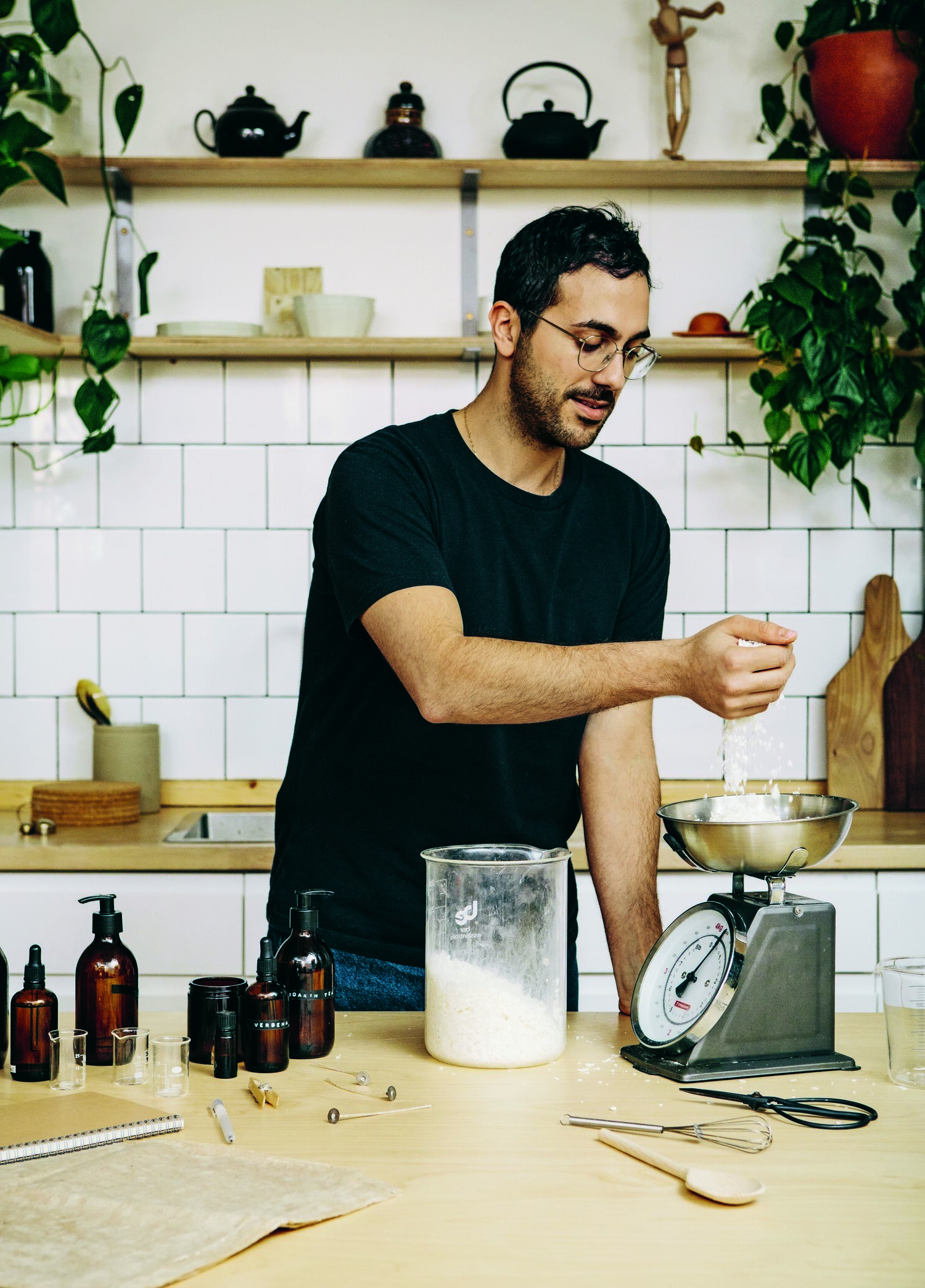
Earl of East founders’ and candle-making experts, Niko Dafkos and Paul Firmin teach us how to make a scented candle at home.
Enter Shop
Honestly, we think that this is a perfect piece of clothing. It’s the first item to be made under our new brand, SGI Threads.
Please scroll down the page to view more images.
First a bit of history.
A lot of people associate our work with Pedlars and The Good Life Experience with the classic vintage workwear jackets that we used to sell. We sold thousands over the course of many years and about twenty years ago we even designed and sold our own British-made version. Either it wasn’t very good, or it was ahead of its time because it didn’t sell well.
Ever since then we have wanted to do another. Now every fashion company makes one and so in order to stand out we decided to try to make one that is truly exceptional. And we genuinely believe that we succeeded.
(Keep reading, plus size info, below.)
At Some Good Ideas part of our mission is to prove that amazing goods can be made in Great Britain and in so doing to show precisely what this costs. We are happy to share any other information so that you, too, can make things here.
At Some Good Ideas we make goods in Britain using the finest components. This is a way to guarantee the very best quality and to prove that it can be done in Britain; it may not be the easiest thing and it definitely isn’t the cheapest, but it is worth the effort. Part of our challenge is that we’re designing our own things and choosing the components, rather than going to a factory -which would be a lot easier- and just saying ’those things you make, please make some for us in a different colour’.
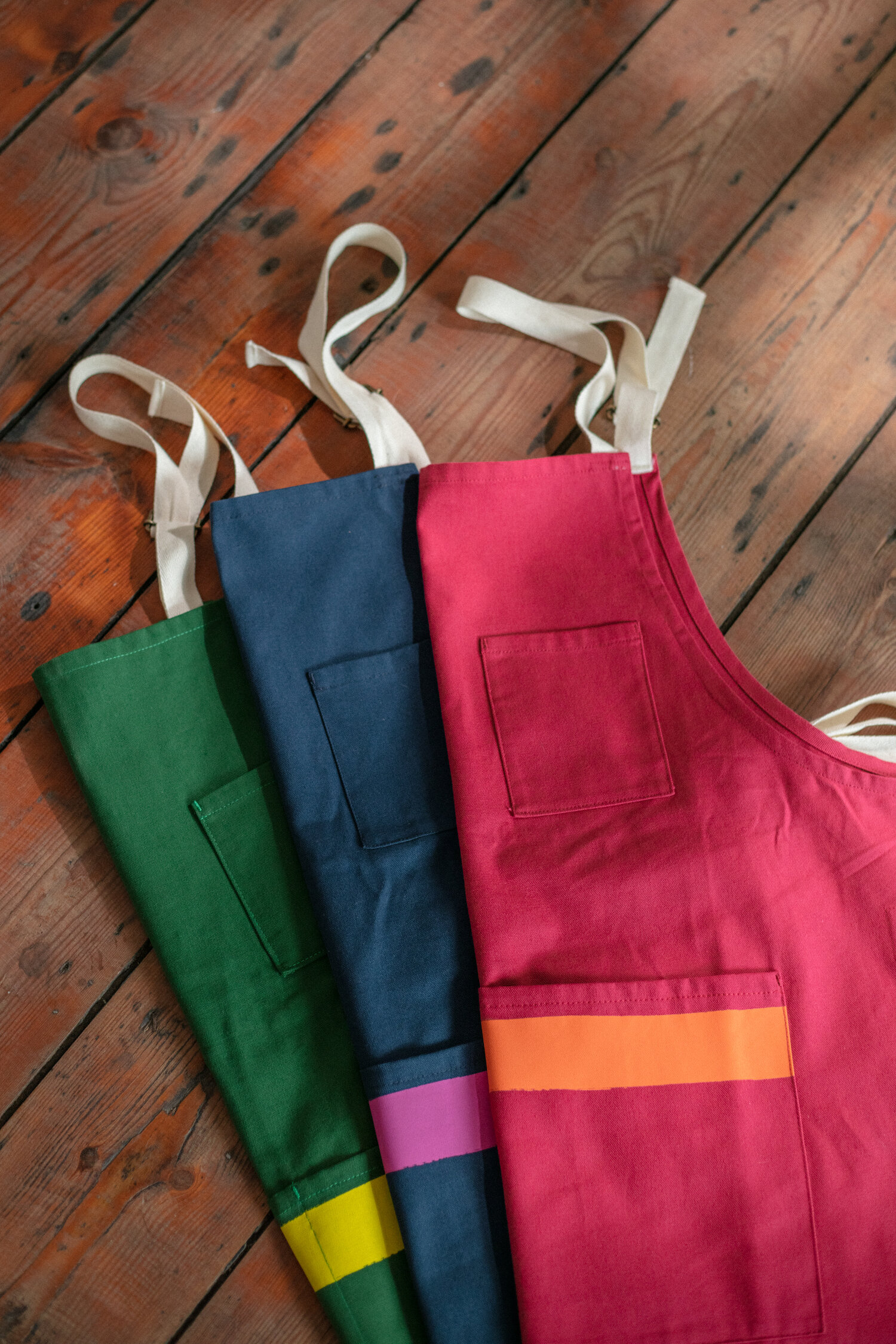
Anyway, here is our apron. It’s taken us five months to build this and it was worth the wait. The original idea was to see if we could make an apron for the staff in The Glynne Arms, one of our sponsors, that reflected their keen eye for the provenance of their food and drink. And, we succeeded. But we’ve made some for other people too -you!- and here they are.
Manufactured in Ipswich. Screen printed in Huddersfield. Tape made in Cheshire. Labels designed and printed in London. Buckles and fabric from Europe.
Everyone needs a To Do list. So, why not buy this one?
Its paper was milled in Scotland, the printing was done in England using Dutch manufactured mineral based inks and vegetable based inks, the glue is from the West Midlands, the manufacture took place in Lincolnshire, the photographs were taken in Sheffield and the design was created in London.
That’s a lot of information for a To Do list, but we’re proud of these facts.
We haven’t cut corners, we’ve kept production in Britain and we’ve paid the people involved a fair price at every step.
This is a To Do list that champions proper manufacture and design.
It’s also just really, really useful.
You should buy one.
100 sheets.
The notepaper in this book is made in Cumbria and the end leaves are made in Britain too, by GF Smith. The cover card is recycled board and is made in Scandinavia.
The book in entirely made in Stamford, GB on a machine built in 1948 and the thread is strong natural linen.
It’s a lovely thing with a mix of lined, checked and plain paper and there’s an elasticated closure.
To find out more about the manufacture and costs involved in making these notebooks, scroll to the bottom of this page where we’ve included lots of detail.
These mugs were hand made in Stoke-on-Trent by someone who is relatively new to the manufacture of tableware but who is employing time-proven, traditional methods of manufacture. The method employed here uses machinery that luxuriates in the unusual name of a Jigger Jolly; this sounds to us like something made up by Roald Dahl but is in fact a piece of machinery that enables the potter to make specific shapes.
This style of mug is a traditional one called a Telford and it uses locally sourced stoneware clay which is strong, vegan and natural. The stripes have been applied by hand using traditional lithographing techniques.
To find out more about the manufacture and costs involved in making these, scroll to the bottom of this page where we’ve included lots of detail.
This was designed for us by colour specialist and designer Gail Bryson and is made in Great Britain. It was printed in Sheffield using environmentally safe inks on Fairtrade organic cotton. The label is also printed in Britain. The cotton was grown on a single origin farm in India which has a long and close relationship with the printers.
To find out more about the manufacture and costs involved in making these towels, scroll to the bottom of this page where we’ve included lots of detail. We’re really trying to be transparent here, because our mission is not just to sell great things but to help people to understand that it’s possible to make good things in Great Britain and what, precisely, this costs. We aim to pay everyone fairly, to make things as sustainably as possible and to support British manufacturers. Inevitably, this means that our goods will cost more than most others, but we think that that is a price worth paying and hope that you’ll agree.
These joyful pencils are made by long-established specialists in Nottingham. The sturdy box (which will last a lifetime in its own right) is made using traditional stitch methods in Nottingham.
The wood used in the pencils is Weymouth Pine which is widely regarded as one of the finest woods for pencil manufacture; it was approved by the Programme for the Endorsement of Forest Certification.
To find out more about the manufacture and costs involved in making these pencils and boxes, scroll to the bottom of this page where we’ve included lots of detail.
Sold as a boxed set of four.
A book by Charlie Gladstone, co-founder of Some Good Ideas, The Good Life Society, Hawarden Estate Experience, Glen Dye Cabins & Cottages, Pedlars and many more.
Words by Charlie.
Illustrated by Matt Blease.
Cover design by James Victore.
Published by our friends at The Do Book Co.
We’re really proud of this book which includes instructions for 35 activities that are suitable for all ages and abilities. This is a book oozing fun, inspiration, knowledge and passion.
The Hand Book started life as a pamphlet that was designed to keep people connected to The Good Life Experience during the weird summer and autumn of 2020. But as we received submissions, we rapidly understood that we had something special on our hands and decided to make a proper book. This was something we’d dreamt of doing for a few years and hadn’t quite got around to; and now it was happening.
Here you’ll find detailed instructions for all sorts of activities from natural dyeing to podcasting, from cooking to learning about trees, from fly fishing to natural navigation, all of which are written eloquently and passionately by experts.
This is a good tea pot.
It’s good because it is made in Britain, it looks amazing, it works well and it’s ethically sourced. Our tea pot was designed by 1882ltd in Stoke-on-Trent by 5th generation makers. No corners were cut in making this product.
We hope that you appreciate its deep integrity and that it offers you years of satisfying use.
To find out more about the manufacture and costs involved in making these tea pots, scroll to the bottom of this page where we’ve included lots of detail. We’re really trying to be transparent here, because our mission is not just to sell great things but to help people to understand that it’s possible to make good things in Great Britain and what, precisely, this costs.
We aim to pay everyone fairly, to make things as sustainably as possible and to support British manufacturers. Inevitably, this means that our goods will cost more than most others, but we think that that is a price worth paying and hope that you’ll agree.