by Xanthe Gladstone
Image: Xanthe GladstoneXanthe ensures the high standard of all food matters, in terms of organic, local and seasonal across The Good Life Society and works constantly to improve our food sustainability, combatting food waste and increasing transparency.
SERVES: 4
COOKS IN: 45 mins
DIFFICULTY: easy
Ingredients
400g spelt
1 red onion
3 cloves of garlic
Half a medium pumpkin (or squash)
A handful of cavolo nero
1 tbsp butter (or olive oil)
12 leaves of sage
1.4L boiling water
70ml white wine
1.5 vegetable stock cubes (or 2 tsp)
200g Harbourne blue cheese
Salt and pepper
Method
Preheat your oven 200°C.
When you are ready to start cooking, put your half pumpkin in the oven with a drizzle of olive oil and some salt and pepper for about 45 minutes at 200°C.
Whilst that’s roasting, dice your onion and cook it on the hob in the butter/olive oil until it is soft. Now add the finely chopped garlic.
Drain the soaking spelt and add it to the onions and garlic, giving it a quick stir around. Dissolve the vegetable stock in boiling water, then add it a little at a time to the spelt. You want to make sure the water has mostly been absorbed by the spelt before adding any more. This whole process should take about 40 minutes.
Once all of the water has been absorbed by the spelt, add the white wine and season well. Let the spelt absorb all of the wine.
While that’s cooking you can make your crispy sage. Add a little bit of olive oil to a hot frying pan, along with the whole sage leaves, and cook until crispy. These will be a delicious topping for your risotto.
Once the pumpkin is soft, cut it in half again and scoop one half out of its skin, adding it to the spelt in spoonfuls. Keep the other half in slices as they will go on top of the risotto with the sage. At this point you can also add the finely chopped cavolo nero, letting it cook for a couple of minutes.
Check that the spelt is cooked and whether it needs any more seasoning. If you don’t think it’s cooked, add some more boiling water a little at a time. If you think it’s ready, take it off the heat and add half of the roughly chopped Harbourne blue cheese.
Serve with a slice of pumpkin, a few leaves of crispy sage, and some extra blue cheese on top.
Tips
Soak the spelt overnight, or, failing that, at least for a few hours before you cook it. This makes it faster to cook and easier to digest.
Our goods are a made in small quantities.

Honestly, we think that this is a perfect piece of clothing. It’s the first item to be made under our new brand, SGI Threads.
Please scroll down the page to view more images.
First a bit of history.
A lot of people associate our work with Pedlars and The Good Life Experience with the classic vintage workwear jackets that we used to sell. We sold thousands over the course of many years and about twenty years ago we even designed and sold our own British-made version. Either it wasn’t very good, or it was ahead of its time because it didn’t sell well.
Ever since then we have wanted to do another. Now every fashion company makes one and so in order to stand out we decided to try to make one that is truly exceptional. And we genuinely believe that we succeeded.
(Keep reading, plus size info, below.)
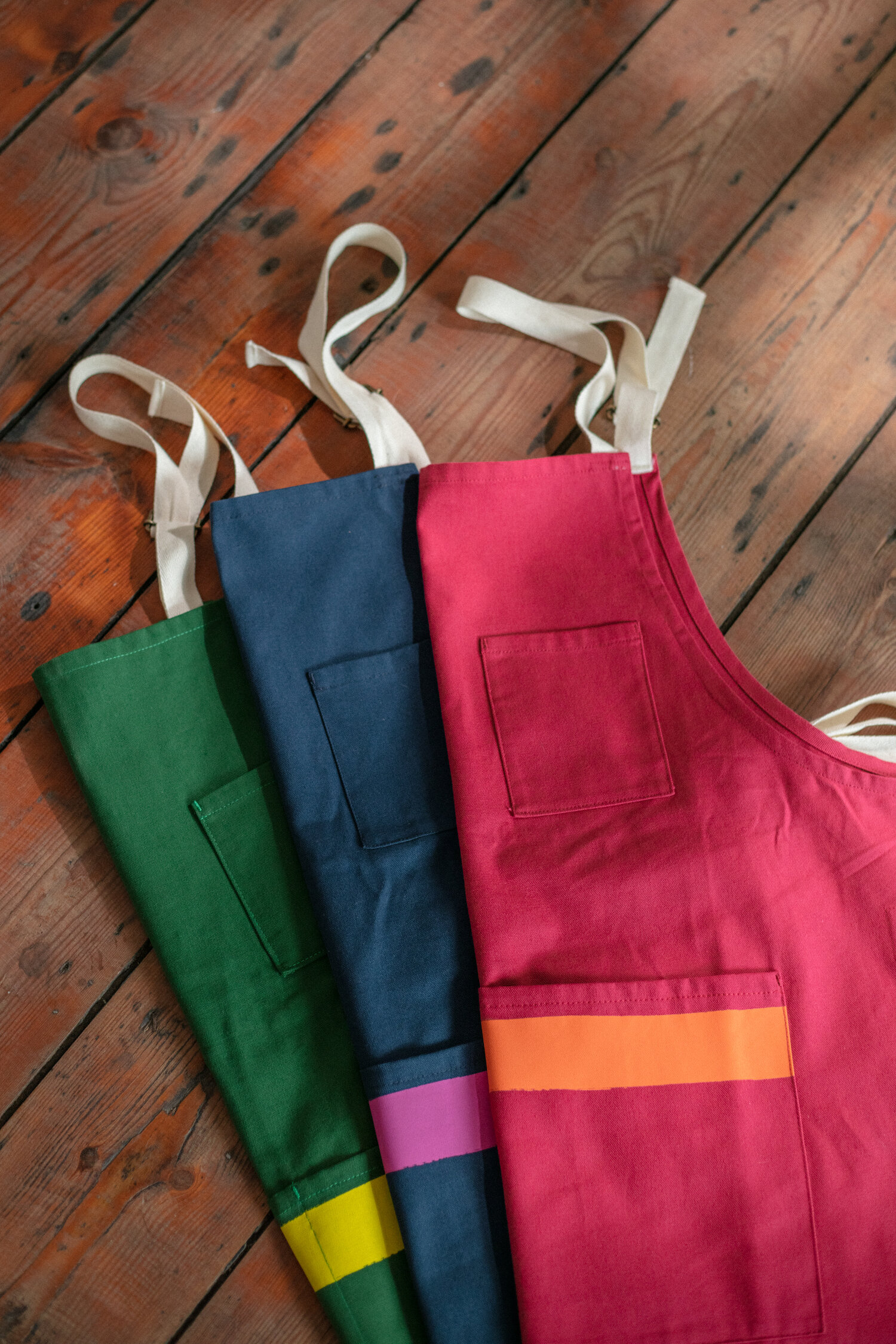
At Some Good Ideas part of our mission is to prove that amazing goods can be made in Great Britain and in so doing to show precisely what this costs. We are happy to share any other information so that you, too, can make things here.
At Some Good Ideas we make goods in Britain using the finest components. This is a way to guarantee the very best quality and to prove that it can be done in Britain; it may not be the easiest thing and it definitely isn’t the cheapest, but it is worth the effort. Part of our challenge is that we’re designing our own things and choosing the components, rather than going to a factory -which would be a lot easier- and just saying ’those things you make, please make some for us in a different colour’.
Anyway, here is our apron. It’s taken us five months to build this and it was worth the wait. The original idea was to see if we could make an apron for the staff in The Glynne Arms, one of our sponsors, that reflected their keen eye for the provenance of their food and drink. And, we succeeded. But we’ve made some for other people too -you!- and here they are.
Manufactured in Ipswich. Screen printed in Huddersfield. Tape made in Cheshire. Labels designed and printed in London. Buckles and fabric from Europe.

Everyone needs a To Do list. So, why not buy this one?
Its paper was milled in Scotland, the printing was done in England using Dutch manufactured mineral based inks and vegetable based inks, the glue is from the West Midlands, the manufacture took place in Lincolnshire, the photographs were taken in Sheffield and the design was created in London.
That’s a lot of information for a To Do list, but we’re proud of these facts.
We haven’t cut corners, we’ve kept production in Britain and we’ve paid the people involved a fair price at every step.
This is a To Do list that champions proper manufacture and design.
It’s also just really, really useful.
You should buy one.
100 sheets.

The notepaper in this book is made in Cumbria and the end leaves are made in Britain too, by GF Smith. The cover card is recycled board and is made in Scandinavia.
The book in entirely made in Stamford, GB on a machine built in 1948 and the thread is strong natural linen.
It’s a lovely thing with a mix of lined, checked and plain paper and there’s an elasticated closure.
To find out more about the manufacture and costs involved in making these notebooks, scroll to the bottom of this page where we’ve included lots of detail.

These mugs were hand made in Stoke-on-Trent by someone who is relatively new to the manufacture of tableware but who is employing time-proven, traditional methods of manufacture. The method employed here uses machinery that luxuriates in the unusual name of a Jigger Jolly; this sounds to us like something made up by Roald Dahl but is in fact a piece of machinery that enables the potter to make specific shapes.
This style of mug is a traditional one called a Telford and it uses locally sourced stoneware clay which is strong, vegan and natural. The stripes have been applied by hand using traditional lithographing techniques.
To find out more about the manufacture and costs involved in making these, scroll to the bottom of this page where we’ve included lots of detail.
Read some articles about The Great Outdoors.
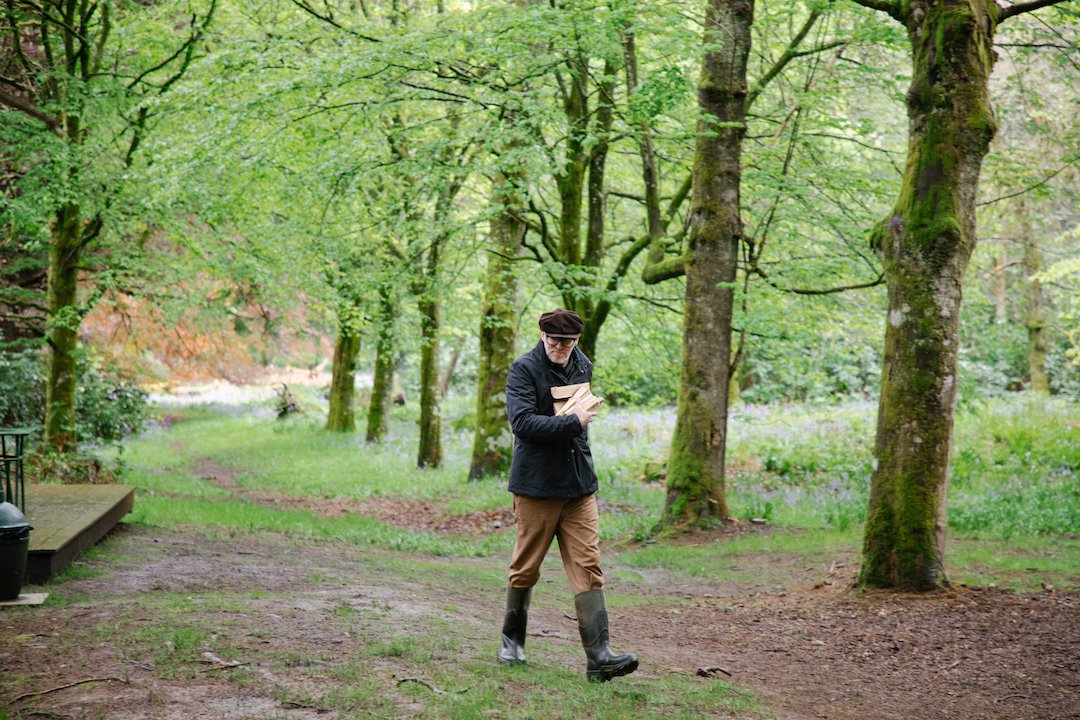
Our thoughts this winter, across our businesses, are focused on getting our guests and customers outdoors. I believe that winter is every bit as good as summer and that our relationship with the colder and darker months has become weirdly soured.
Autumn and winter last for about half the year, so we might as well try to make the best of them.
So here’s a short piece on my favourite kit -indoor and outdoor- for winter.


Roger Phillips is a mushroom maestro and one of the most respected foragers in Great Britain.
In 1975 he began his life’s major work, photographing an encyclopaedic collection of world plants and he has since written 20 additional volumes with combined sales of 4.5 million copies worldwide.

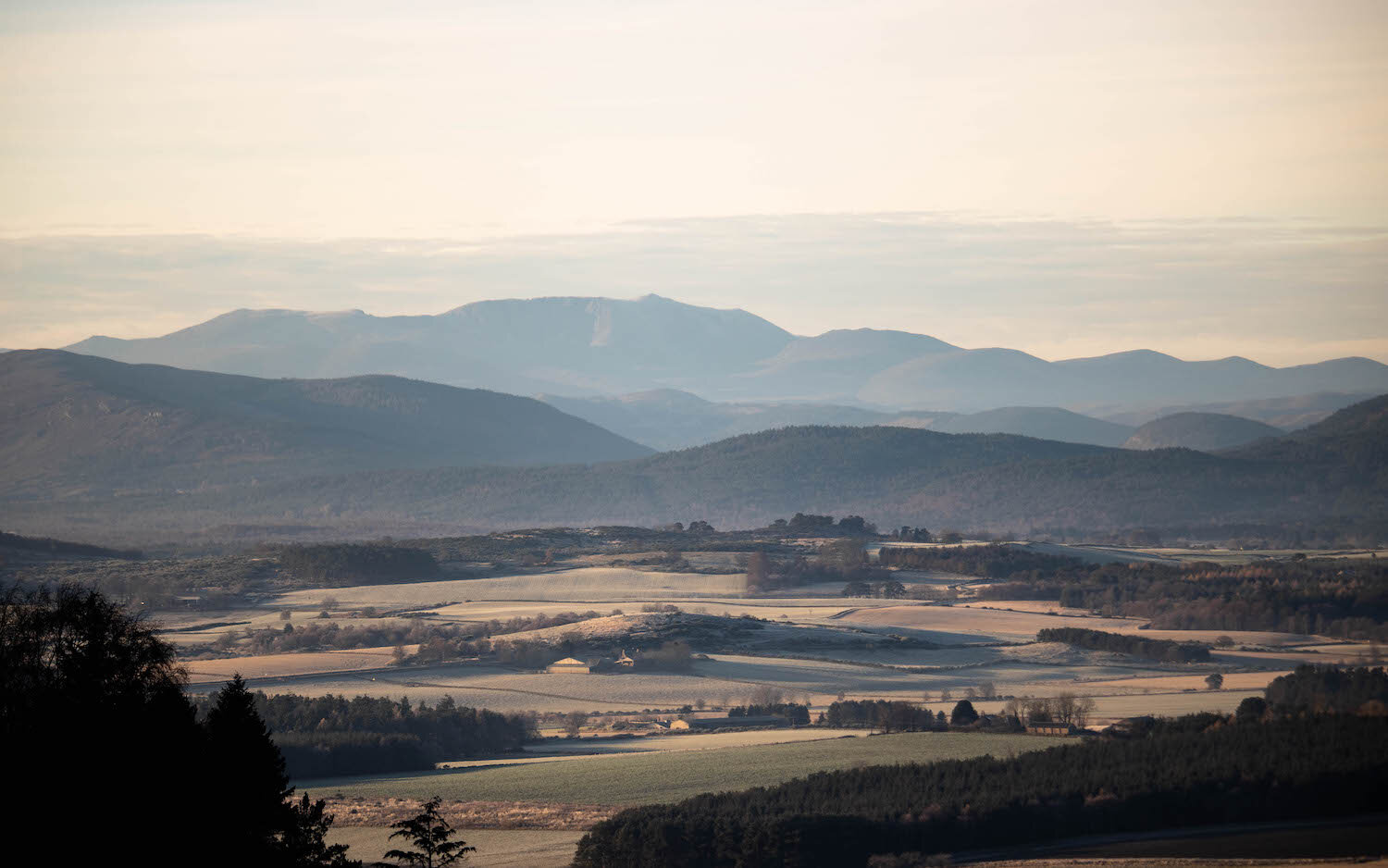
In 1989 Charlie & Caroline Gladstone, SGI co-founders, upped sticks in London and moved to Glen Dye, Kincardineshire to raise their family.
They would go on to quite literally write the book on The Great Outdoors, and have always championed and befriended those who carve a life out for themselves in the countryside.
With a great exodus now taking place in our cities, these are the stories of those who call the countryside their home.
We asked them to speak about their favourite month in the country.

Tree-watching is a very under-rated hobby.
We tend to pass trees by, acknowledging them as part of the landscape, and paying more attention to wildflowers or wildlife. But once you start to recognise trees and to really observe them, they are every bit as fascinating and rewarding.

Chickens. They’re everywhere. No, seriously!
As least twice a day I get up from my desk and head outside to wave my arms around in a fashion similar to tai-chi in attempt to usher chickens safely back into The Walled Garden.
Charlie is here to talk to us about what he sees as the personal benefits of walking and then standing still.
As a retired (for now) runner and an incredibly active (in mind and body) person, we’re excited to hear Charlie speak on these subjects.

This is a good tea pot.
It’s good because it is made in Britain, it looks amazing, it works well and it’s ethically sourced. Our tea pot was designed by 1882ltd in Stoke-on-Trent by 5th generation makers. No corners were cut in making this product.
We hope that you appreciate its deep integrity and that it offers you years of satisfying use.
To find out more about the manufacture and costs involved in making these tea pots, scroll to the bottom of this page where we’ve included lots of detail. We’re really trying to be transparent here, because our mission is not just to sell great things but to help people to understand that it’s possible to make good things in Great Britain and what, precisely, this costs.
We aim to pay everyone fairly, to make things as sustainably as possible and to support British manufacturers. Inevitably, this means that our goods will cost more than most others, but we think that that is a price worth paying and hope that you’ll agree.